
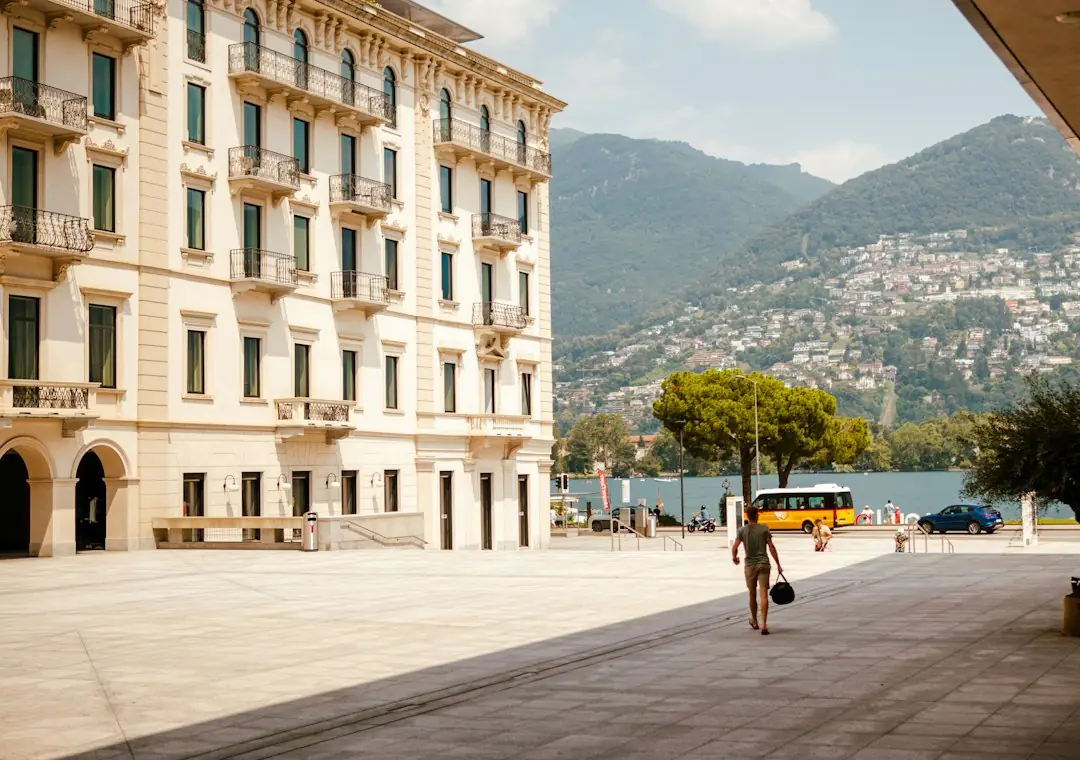
Most of what you read about digital marketing is written for large markets, where the problem is rising above the noise. In Lugano the problem is close to the opposite: the market is narrow, the people who matter know each other, and the number of realistic clients for a professional service in a year can be counted without a calculator.
That changes the objectives. Collecting a lot of enquiries is not a success: it is a way of filling the diary with conversations that lead nowhere. What follows is what works when the catchment is small and word of mouth weighs more than advertising.
In a Narrow Market, Volume Is the Wrong Metric
In a big city the reasoning is statistical: raise the number of enquiries, hold a conversion rate, get more clients. In a small catchment that reasoning stops working, because the limit is not how many enquiries you collect but how many companies exist that genuinely need what you sell. In the sectors that weigh most here, from wealth management to fiduciary firms to professional practices, that number is low and you could almost list it.
The practical consequence is that qualifying matters more than generating. Ten conversations with people who can buy are worth more than two hundred completed forms, and they cost far less to handle.
Measurement changes too. A low cost per enquiry says nothing if those enquiries were never in the market. The useful question is how many of those conversations reached a quote.
The Site Doesn't Get You Discovered, It Gets You Checked
Where word of mouth works, the first encounter with your name is rarely online. Someone hears it over dinner, in a meeting, from a colleague. In a city where the same names come up at the same tables, that happens more often than elsewhere. Then they go and look it up. The site is not the channel that introduces you: it is the one that confirms or demolishes what they have just heard about you.
That changes what has to be on it. You are not convincing a stranger from scratch, you are answering someone who is already checking. Who you are, what exactly you do, who you have done it for, and how to get in touch. If any one of those four takes more than a few seconds to find, the check goes badly.
A slow or badly built site does its damage right here, because this is the one moment it gets looked at properly.
Discretion Is Part of the Service
In several sectors here the client does not want to appear. They will not sign a testimonial, they do not want their name in a case study, and in some cases they could not give it anyway. Marketing built on public references is left with nothing to use.
The proof then has to be structural rather than anecdotal: how you work, with what method, with what skills, what questions you ask before taking on a job. It is less eye catching than an enthusiastic quote, and it holds up better under the gaze of someone assessing you seriously.
The same applies to how people reach you. A form asking for turnover and headcount before there has even been a conversation pushes away exactly the people you wanted.
Not All Your Clients Read Italian
Lugano works in Italian, but not only. It sits in an Italian speaking canton in a country where most of the market works in German or French, and it often turns out that the client's head office, the partner or the person who actually decides sits in Zurich. Added to that are the people who come from across the border. A site in a single language is not wrong by definition, but it is a choice, and it is worth making it by looking at where the enquiries come from rather than out of habit.
If a whole extra language is too much, start with the pages that count: what you do, who you are, how to contact you. Translating the entire blog is rarely the first useful step.
Price Says Something Before You Speak
Competing on price here is a hard position to defend, and not only because the client is not looking to save money. Milan is about an hour away, and a cheaper Italian supplier is something your client can find without any effort. On that ground the game is lost before it starts. Someone choosing a professional in Lugano is buying reliability and proximity, and a price well below everyone else's reads as a signal, not as a bargain.
That does not mean displaying high figures. It means the copy should explain what is included and why, instead of leaning on comparison. Clarity convinces more than a discount.
Do You Need an Agency Based in Lugano?
Not necessarily. We work remotely, with our operations base in Durrës and a team that writes and calls in Italian. We look after businesses in Italy, Switzerland, the rest of Europe and the United States, and every enquiry is called and qualified before it reaches the client.
What we do not have is a physical presence in Switzerland, and there is no point pretending otherwise. What counts is who knows your market and who answers when an enquiry lands.
If your work does not stop at the city, the guide to the canton is worth reading too: outside Lugano the picture changes quite a bit.
The Short Version
- In a narrow catchment the number of enquiries says little: what counts is how many were really in the market.
- The site is there to be checked by people who have already heard your name, not to get you discovered.
- Where the client will not appear, the proof is your method, not a testimonial.
- Part of your own client base reads in German or in English: look at where your enquiries come from.
- With Milan an hour away, competing on price is lost ground: the position is proximity and reliability.
Frequently Asked Questions
Is online advertising worth it in a market this small?
Yes, but with different objectives from the usual ones. In a narrow catchment, campaigns are there to get you found by people already searching and to stay present for a small number of relevant people, rather than to generate volume. Keep the budget contained and judge it on useful conversations, not on the number of enquiries.
Do you need a site in more than one language in Lugano?
It depends on who your clients are. If some of them work in German or in English, at least the main pages should be readable in those languages. Before deciding, look at where the enquiries you already receive come from: that is data you have in house, and it answers better than any general rule.
Do you work with Swiss companies without having an office in Switzerland?
Yes. We work remotely from Durrës, in Italian, English, Spanish and Albanian, and we look after businesses in Italy, Switzerland, the rest of Europe and the United States. We have no offices in Switzerland and we do not present ourselves as a local agency: what we offer is running the channels and qualifying every enquiry before it reaches you.
Keep Reading
Related service: website design and build
Let's talk about your situation
Back to Blog